
.png)
From Gut Feel to Growth Engine: Operationalising Intuition in Marketing Strategy
Intuition is the unsung hero of high-performing marketing teams. But left untested, it can be your blind spot. This guide shows you how to capture instinct, test it, avoid common pitfalls, and embed it into a strategy you can scale.
The Quiet Power of Instinct
Most experienced marketers have a sixth sense for what works. Years in the trenches create a store of insights no dashboard can replicate. But as teams grow, that edge often gets buried under too much process or too much data.
Smart organisations don’t crush instinct — they build a system to use it wisely.

Gut Feel Alone Isn’t Enough
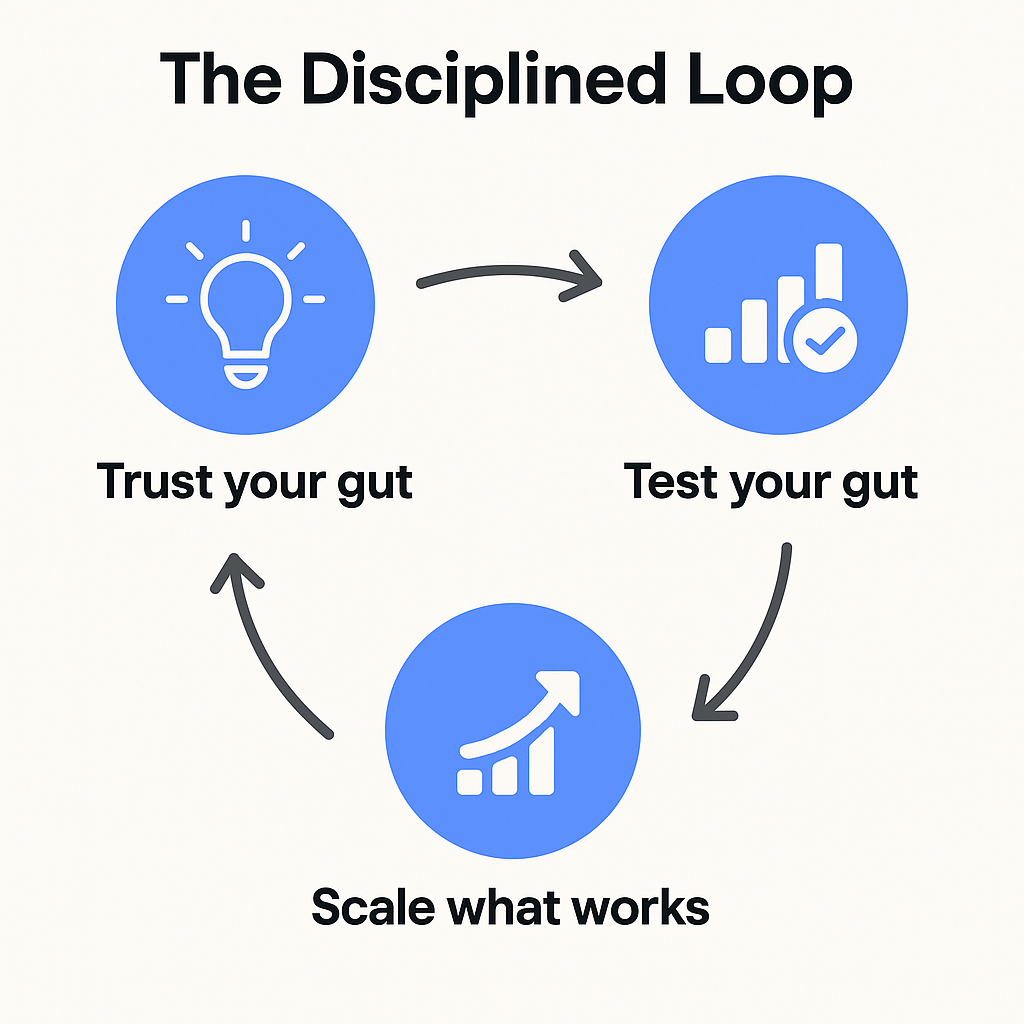
A hunch is gold — until it isn’t. Over-reliance on instinct leads to big, risky bets. Blind faith in data causes analysis paralysis and bland campaigns. High-performance marketing sits in the middle: Trust your gut. Test your gut. Scale what works.
Introducing The Disciplined Loop
Intuition shouldn’t be random inspiration — it should feed a repeatable system. That’s where The Disciplined Loop comes in. This simple cycle helps your team turn instinct into insight, insight into action, and action into confident growth — again and again.
Use it as your mental checkpoint every time a hunch arises: Trust it. Test it. Scale it.
Turn Instinct Into Testable Hypotheses
When you hear yourself say, “I just know this will resonate” — pause. Make it testable:
- Hunch/Intuition:
Write it down.
- Hypothesis:
State what you believe will happen.
- What proves it true?
Define clear success signals.
- What proves it false?
Be honest — what would disprove it?
- Smallest test:
What’s the lightest lift to check?
- Metrics to track:
Pick only what matters.
- Result:
What did you find?
- Learnings/Next steps:
How does this inform your next move?
Practical Testing Examples
- B2B SaaS:
Run a short LinkedIn ad to test demand for a new pain point narrative before rewriting your website.
- E-commerce:
A/B test a bold vs. classic product description to see which converts better.
- Non-profit:
Use an Instagram story poll to check if a younger audience prefers a new campaign theme.
Qualitative + Quantitative: Use Both
Data is powerful, but customer stories often spark the best hunches. Balance both:
- Listen to sales and support calls.
- Watch session recordings to spot hidden friction.
- Read survey comments, not just scores.
Sometimes your gut is just your pattern-recognition engine whispering insights the spreadsheet missed.
Rituals and Tools to Systematise It
Practical tools & rituals:
Hypothesis Board:
Use Trello, Asana or even a simple Google Sheet. Make it visible to the whole team.
Fast Feedback Loops:
Commit to short test cycles — weeks, not months.
Retros:
Celebrate lessons from both hits and misses. This builds safety for sharing bold ideas.
Bonus tools: For A/B testing, tools like Optimizely, VWO, or your email platform’s built-in tests work well.
Common Pitfalls & How to Avoid Them
Free Template: Hypothesis Board
Make your disciplined loop real — and repeatable — with this practical one-page template. The Hypothesis Board helps your team capture gut instincts, frame them as testable ideas, run low-risk experiments, and document what works (and what doesn’t).
What’s inside:
- Hunch / Intuition: Capture the raw idea, no filter.
- Hypothesis: Turn the hunch into a clear, testable statement.
- What proves it true? Define success signals upfront.
- What proves it false? Spot confirmation bias before it creeps in.
- Smallest test: Identify the quickest, lowest-cost way to test your idea.
- Metrics to track: Stay focused on the signals that matter.
- Result: Record what really happened.
- Learnings / Next steps: Decide whether to scale, tweak, or scrap.
Download it free — and make intuition your team’s repeatable growth engine.
Overcome Cultural Barriers
Even a great process fails without a supportive culture:
- Sell it to leadership: Position micro-tests as low-risk insurance, not guesswork.
- Build psychological safety: Praise people for sharing hunches, not just validated data.
- Protect the time: Reserve capacity for small, rapid experiments within the big plan.
Final Thought
Your experience is priceless — but only if it’s captured and shared. Systemise your intuition and you turn it into a renewable resource for growth.
Ready to unleash your team’s intuitive power?
Start today: write down your next hunch, frame it as a hypothesis, run a small test — and watch your gut become a growth engine.

Related posts
.png)
.png)
.png)
Like what you’re reading?
Sign up to my newsletter.
No noise. Only honest strategy, occasional reflection, and the kind of insights you actually want in your inbox.